

Mobile App Development Services: A Complete Guide for Businesses
Mobile app development services help businesses plan, design, build, test, and maintain smartphone and tablet applications. Whether you run a startup or an established company, a well-designed mobile app can improve customer experience, automate operations, and create new revenue opportunities.
What Is a Mobile App Development Service?
A Mobile App Development Service covers the full process of creating an application for Android, iOS, or both. It may include market research, UI/UX design, coding, testing, deployment, maintenance, and future upgrades.
For Indian businesses, mobile apps are becoming increasingly important because customers prefer quick, convenient, and personalised digital experiences. A business app can make services available around the clock while reducing manual work.
Types of Mobile App Development
| App Type | Best For | Main Advantage |
| Native apps | High-performance projects | Fast and reliable |
| Cross-platform apps | Startups and SMEs | One codebase for Android and iOS |
| Progressive Web Apps | Budget-conscious businesses | Works through a web browser |
| Custom business apps | Unique business requirements | Tailored features and integrations |
Custom Mobile App Development is suitable when standard software cannot meet a company’s workflow, branding, security, or customer-service requirements.
Important Features of a Business Mobile App
Depending on the business model, an app may include:
- Secure registration and login
- Product or service catalogue
- Online payment integration
- Push notifications
- GPS and location tracking
- Live chat or customer support
- Appointment or order management
- Admin dashboard and analytics
- Social media integration
- Data security and privacy controls
How Does Mobile App Development Work?
A development company first understands the business problem, target users, required features, and budget. It then prepares the app structure and visual design. After approval, developers build the application, test its performance, and publish it on the relevant app stores.
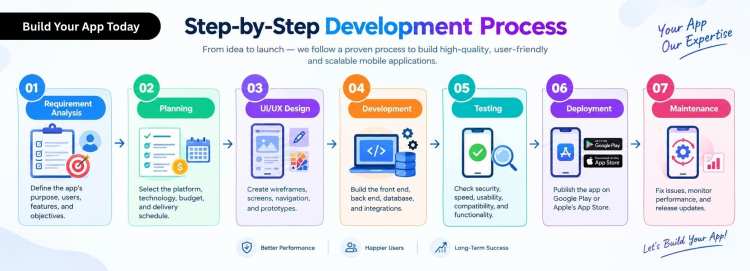
Step-by-Step Development Process
- Requirement analysis: Define the app’s purpose, users, features, and objectives.
- Planning: Select the platform, technology, budget, and delivery schedule.
- UI/UX design: Create wireframes, screens, navigation, and prototypes.
- Development: Build the front end, back end, database, and integrations.
- Testing: Check security, speed, usability, compatibility, and functionality.
- Deployment: Publish the app on Google Play or Apple’s App Store.
- Maintenance: Fix issues, monitor performance, and release updates.
Benefits and Limitations
The major benefits include improved customer engagement, stronger brand visibility, faster service delivery, business automation, direct communication, and better access to customer insights.
However, mobile apps also require an initial investment, regular maintenance, security monitoring, app-store compliance, and continuous updates. An app without a clear purpose may fail to attract or retain users.
Common Mistakes to Avoid
Businesses often add too many features in the first version, ignore user research, choose technology only on the basis of price, or launch without proper testing. Weak security, complicated navigation, and the absence of a maintenance plan can also affect long-term success.
Practical Best Practices
Start with a Minimum Viable Product containing only essential features. Choose an experienced development partner, request a written scope of work, and clarify ownership of the source code. Test the app with real users and track performance after launch.
When selecting a provider for Mobile Application Development in Meerut or elsewhere in India, review its portfolio, technical expertise, communication process, client feedback, support terms, and data-security practices.
Frequently Asked Questions
1. Which platform should a business choose for its mobile app?
It depends on where your customers are. If most of your users have Android devices, starting with Android may make sense. If your audience uses both Android and iPhone, developing for both platforms can help you reach more customers.
2. Is custom app development a good option for startups?
Yes. Startups don’t always need to build a large application from day one. A practical approach is to start with an MVP (Minimum Viable Product) that includes the essential features. Once you understand how customers respond to it, you can add more features and scale the app.
3. How long does it take to develop a mobile app?
The timeline depends on the type and complexity of the application. A simple app may take around 8–12 weeks, while a more advanced application with complex features and integrations can take four to six months or more.
4. What factors affect the cost of mobile app development?
There isn’t a fixed price for every app. The overall cost depends on factors such as the number of features, UI/UX design, platforms, third-party integrations, security requirements, technology stack, testing, and ongoing maintenance.
5. Can the same app work on both Android and iOS?
Yes. Cross-platform development allows businesses to build apps for Android and iOS using a shared codebase. This can make development and future updates more efficient, depending on the project’s requirements.
6. Does a mobile app need regular maintenance?
Yes. Launching the app is only the beginning. Regular maintenance helps keep the application secure, compatible with newer operating-system versions, free from bugs, and performing smoothly. Updates may also be needed when you introduce new features or make improvements.
7. Who owns the app’s source code after development?
Source-code ownership depends on the agreement between the business and the development company. Before starting the project, make sure the contract clearly explains source-code ownership, intellectual property rights, licenses, and access to the final project files.
8. How can a business choose the right mobile app development company?
Don’t make the decision based on price alone. Look at the company’s previous projects, relevant industry experience, development process, client feedback, pricing transparency, security practices, communication, and post-launch support. A reliable development partner should be able to understand your business goals—not just build the app.
Conclusion
A well-designed mobile app can do much more than simply put your business on a customer’s phone. It can help you connect with customers, simplify everyday tasks, improve communication, and create a better overall user experience.
The right approach depends on your business goals, target audience, required features, budget, and the technology used to build the app. Instead of trying to include everything at once, it is often better to start with the features that matter most and build from there.
Before investing in development, clearly define what you want the app to achieve and discuss your requirements with an experienced development team. A detailed consultation and project estimate can help you understand the expected timeline, cost, technology, and development process.
Disclaimer: The costs and timelines mentioned in this article are general estimates for guidance only. Actual development time, pricing, features, performance, and results can vary depending on the project’s requirements, complexity, technology, and service provider.