Businesses are always looking for better ways to manage their work, serve customers, reduce costs, and make informed decisions. As operations become more complex, traditional software alone may not be enough to meet every business requirement. This is where enterprise AI is beginning to make a real difference.
Today, companies are moving beyond simply using AI tools to write emails or answer questions. They are exploring how to connect AI with their existing software, company data, internal processes, and security systems.
The goal is straightforward: build business systems that help people work more efficiently without putting confidential information or essential operations at risk.
The future of enterprise AI will not depend only on how powerful an AI model becomes. It will also depend on how securely and effectively businesses can use that technology in their everyday operations.
What Is Enterprise AI?
Enterprise AI refers to the use of artificial intelligence within an organisation to improve business operations, support employees, analyse information, and automate selected tasks.
Unlike a standalone AI chatbot, an enterprise AI solution can be connected to approved business applications, databases, customer relationship management systems, enterprise resource planning software, and internal knowledge resources.
For example, a manufacturing company might use AI to analyse inventory levels and identify potential stock shortages. A service company could use it to organise customer enquiries, while a financial team might use it to review documents and prepare reports for human approval.
The value comes from applying the technology to actual business needs rather than adopting it simply because it is available.
From AI Models to Complete Business Systems
An AI model is only one part of a larger business solution.
A model may understand questions, summarise documents, generate text, or identify patterns in data. However, a business usually needs much more than that before it can rely on the technology for daily work.
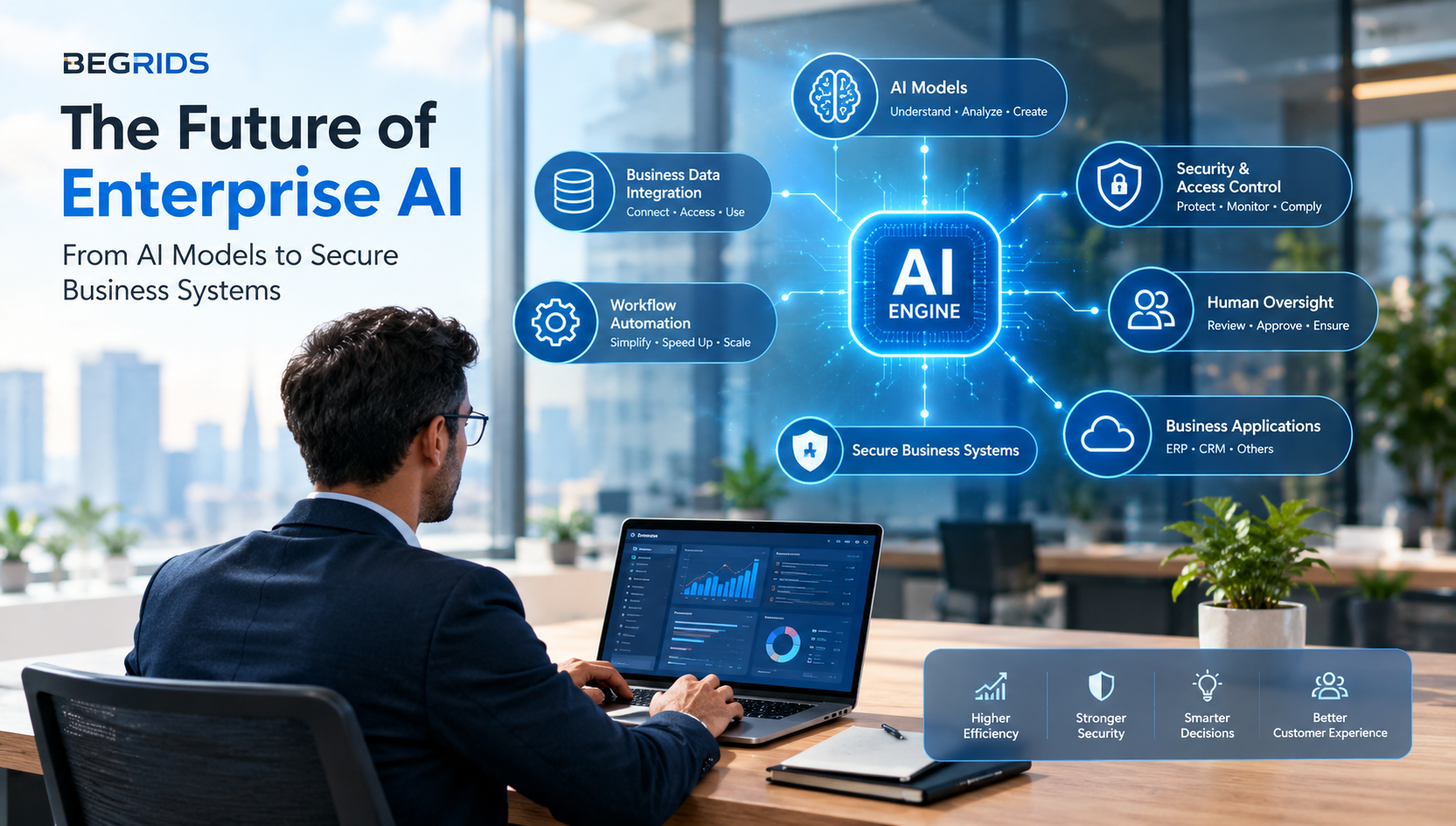
A complete enterprise AI system may include:
- AI models: Process information and generate useful responses.
- Business data integration: Connect approved databases, documents, and software applications.
- Workflow automation: Carry out permitted tasks according to business rules.
- Access controls: Ensure employees can access only the information they are authorised to see.
- Security monitoring: Track activity and identify unusual behaviour.
- Human approval: Allow authorised staff to review important decisions and actions.
Consider a company that receives hundreds of customer enquiries every day. An AI model can classify incoming messages, but a complete system can also direct each enquiry to the correct department, create a support ticket, prepare a suggested response, and record the activity.
The difference is important. One provides a capability; the other turns that capability into a practical business process.
Why Enterprise AI Security Matters
Businesses handle information that should not be available to everyone. This may include customer records, employee details, financial reports, contracts, pricing information, and internal business strategies.
Introducing AI into these environments creates new responsibilities. Companies must understand where information goes, who can access it, how long it is retained, and whether it can be used for purposes beyond the original request.
Enterprise AI security should be planned from the beginning, not added after the system has already been deployed.
Important safeguards include:
1. Controlled access to business data
Employees and applications should receive access only to the information required for their roles. An AI assistant should not automatically gain access to every company database simply because a connection is technically possible.
2. Data privacy and protection
Sensitive information should be protected during transmission and storage. Businesses should also review the data-handling terms of any external AI provider they use.
3. Secure integrations
Connections to accounting software, CRM platforms, ERP systems, and internal databases should use properly managed credentials, restricted permissions, and validated requests.
4. Activity logs and monitoring
Organisations need a clear record of important system activities, including data access, automated actions, approval decisions, and failed requests.
5. Human oversight
AI-generated results can contain mistakes. Financial transactions, employee decisions, legal commitments, and other high-impact actions may require additional checks and approval.
Security is not a single feature. It is a combination of technology, access policies, testing, monitoring, and responsible management.
How Enterprise AI Can Improve Business Operations
One of the strongest reasons to invest in enterprise AI is its ability to support existing teams and reduce repetitive work.
1. Business process automation
Many organisations spend significant time transferring information between applications, preparing reports, checking documents, and responding to routine requests.
AI business automation can help classify information, extract relevant details, prepare draft responses, and trigger predefined workflows. Traditional automation can then handle predictable steps, while employees manage exceptions and decisions that require judgement.
This approach can reduce manual effort while keeping important business rules in place.
2. Smarter customer support
AI-powered customer support systems can help answer common questions, find relevant information, summarise previous conversations, and route complex cases to the appropriate team.
When connected to approved company knowledge, these systems can provide more relevant answers than a general-purpose chatbot.
Businesses should still make it easy for customers to reach a human representative, particularly when a question involves complaints, sensitive information, or an unusual situation.
3. Better reporting and decision support
Enterprise AI can help employees understand large amounts of business information by summarising reports, identifying unusual changes, and answering questions in everyday language.
For example, a manager could ask which products experienced the largest decline in sales during a particular period. The system could retrieve the relevant figures and prepare a summary for review.
The underlying data, calculation methods, and reporting permissions remain important. AI-generated explanations should be checked against reliable business records before major decisions are made.
4. Knowledge management
Large companies often have valuable information spread across documents, emails, policies, and internal knowledge bases.
Employees may spend hours searching for the correct procedure or the latest version of a document.
An enterprise knowledge assistant can help locate relevant information and summarise it, ideally with links to the original sources. This makes company knowledge easier to use without requiring employees to search multiple systems manually.
5. ERP and CRM integration
Enterprise AI becomes more useful when it works alongside software that already runs the business.
Integration with ERP software can support inventory analysis, purchase planning, reporting, and operational monitoring. CRM integration can help sales teams summarise customer histories, prepare follow-ups, and identify pending enquiries.
The objective is not necessarily to replace existing software. It is to make that software more useful while preserving established workflows and controls.
Choosing the Right AI Model Is Only the Beginning
Businesses often focus on which AI model is the most powerful, but selecting a model should be based on the task it needs to perform.
A company may need one model for document summarisation, another approach for extracting structured information, and a conventional software process for calculations or financial transactions.
When evaluating enterprise AI solutions, consider the following factors:
- Accuracy on real business tasks.
- Support for the required languages and document formats.
- Data privacy and contractual requirements.
- Response speed and operating costs.
- Integration with existing applications.
- Availability, scalability, and ongoing maintenance.
- Options for human review and error correction.
Some organisations may benefit from a hosted AI service. Others may need a private deployment or a combination of different approaches because of their data protection requirements.
There is no single solution that suits every business. The right choice depends on the organisation's objectives, technical environment, budget, and acceptable level of risk.
Building Secure AI Systems for the Future
A successful enterprise AI implementation requires more than connecting an application to an AI API. It needs a clear architecture, defined permissions, reliable data flows, and a plan for ongoing maintenance.
A practical implementation process can follow these steps.
Step 1: Identify a specific business problem
Start with a repetitive task or a process where employees regularly lose time. Define what improvement would look like before selecting a technology.
Step 2: Review the available data
Identify the information required, where it is stored, who owns it, and whether it contains confidential or regulated information.
Step 3: Design the system and its permissions
Decide which applications need to connect, which actions are allowed, and which tasks require approval. Keep access limited to what is necessary.
Step 4: Develop a small pilot
Test the solution with a limited group of users and realistic business data. Measure accuracy, response times, costs, and the amount of manual work saved.
Step 5: Test security and reliability
Check access restrictions, unexpected inputs, incorrect outputs, integration failures, and attempts to access unauthorised information.
Step 6: Expand gradually
Introduce the system to additional teams only after the pilot demonstrates reliable results. Monitor performance and update the solution as business requirements change.
This measured approach helps organisations avoid unnecessary investment and identify practical problems before they affect a wider operation.
Common Challenges Businesses Should Prepare For
Although enterprise AI offers useful opportunities, implementation is not always straightforward.
Poor data quality: Incomplete, outdated, or inconsistent records can produce unreliable results.
Integration difficulties: Older software may lack suitable interfaces or require additional development before it can exchange information securely.
Unpredictable responses: AI systems may misunderstand requests, overlook important details, or generate incorrect information.
Unclear ownership: Without defined responsibilities, teams may not know who approves changes, reviews results, or responds to security incidents.
Unmeasured costs: Model usage, infrastructure, integration work, monitoring, and maintenance all contribute to the overall cost.
These challenges can be managed through proper planning, testing, clear ownership, and regular reviews. Businesses should also establish measurable targets, such as reduced processing time, fewer manual errors, faster customer responses, or improved reporting accuracy.
What Does the Future of Enterprise AI Look Like?
The next stage of enterprise AI is likely to focus increasingly on integration, governance, and practical outcomes.
Businesses will continue exploring systems that can work across multiple applications, retrieve information from approved sources, and complete defined tasks with appropriate supervision.
Smaller, specialised models may also become useful for organisations that need predictable performance, lower operating costs, or more control over where processing takes place.
At the same time, access management, audit trails, data protection, and human accountability will remain essential. As AI systems become more closely connected to business operations, the consequences of poor configuration or excessive permissions can become more significant.
The companies that benefit most will not necessarily be those that adopt the newest technology first. They will be those that identify meaningful problems, implement suitable solutions, protect their information, and continually measure the results.
Final Thoughts
The future of enterprise AI is about building reliable business systems, not simply choosing a powerful model.
When AI is combined with secure data access, well-designed workflows, existing business software, and appropriate human oversight, it can help organisations reduce repetitive work and make better use of their information.
For businesses considering this transition, the best starting point is a clear operational need and a realistic implementation plan.
At BeGrids, we believe business technology should solve practical problems, support employees, and grow with the organisation. With the right approach to software development, business automation, and secure system integration, companies can build a stronger foundation for their future operations.
Looking to modernise your business systems? Explore how custom software development, business automation, and secure application integration can support your organisation's goals.
Visit BeGrids to learn more about business software and digital solutions.
Frequently Asked Questions
1. What is enterprise AI used for?
Enterprise AI is used to support business operations through document processing, customer support, reporting, knowledge management, workflow automation, and analysis of company data.
2. How is enterprise AI different from a regular AI chatbot?
A regular chatbot may answer questions or generate content. An enterprise AI system can also connect to authorised business data and applications, follow defined workflows, and operate within company access and security policies.
3. How can businesses use AI securely?
Businesses can improve AI security through restricted data access, encryption, secure integrations, activity logging, privacy reviews, regular testing, and human approval for sensitive actions.
4. Can enterprise AI integrate with ERP and CRM software?
Yes. Depending on the software's available interfaces and permissions, enterprise AI can integrate with ERP, CRM, accounting, inventory, customer support, and other business applications.
5. Is enterprise AI suitable for small and medium-sized businesses?
Yes. Small and medium-sized businesses can begin with focused projects such as customer enquiry management, document processing, reporting, or repetitive administrative tasks. The solution should match their needs and budget.
6. Does enterprise AI replace existing business software?
Not necessarily. In many cases, AI adds capabilities to existing software. Integration can improve how employees access information and manage workflows without requiring the organisation to replace every application.
7. What should a company consider before implementing enterprise AI?
A company should define its business objective, assess data quality, review security requirements, evaluate integration options, estimate costs, test performance, and establish a process for monitoring the results.