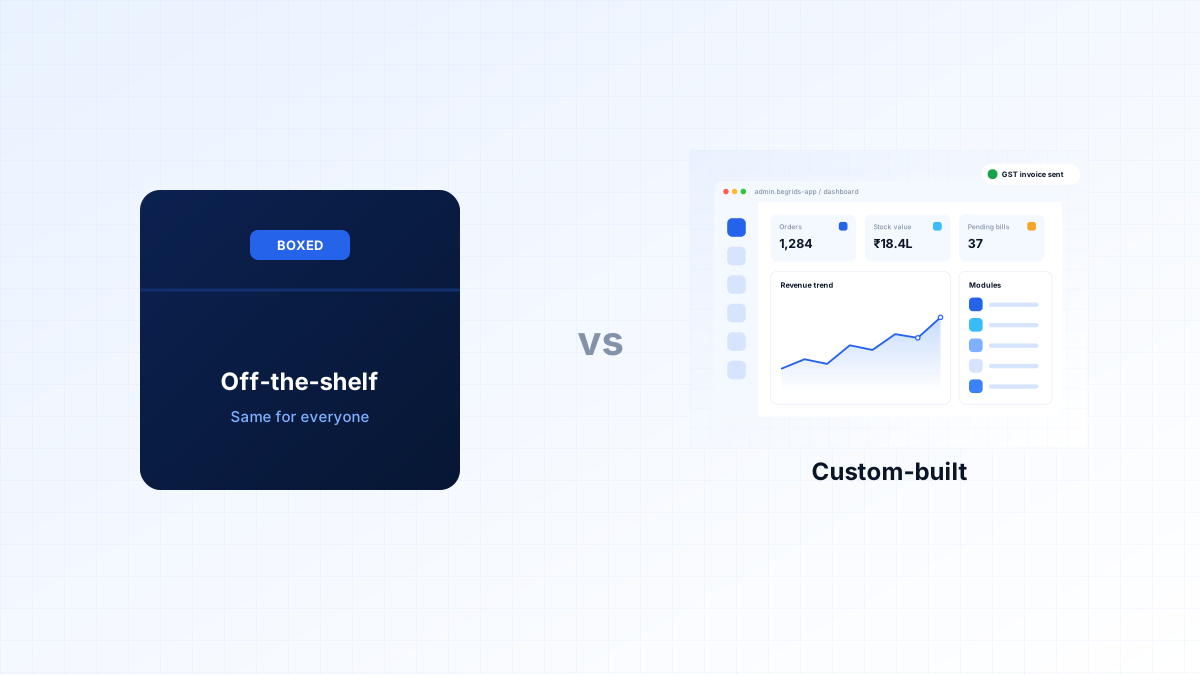
Every growing business eventually reaches a point where spreadsheets and basic tools are no longer enough. The next question is usually: do we buy a ready-made product or build something of our own? Both options can be the right answer. The mistake is choosing one by default without looking at how your business actually works.
What we mean by each option
Off-the-shelf software is a ready-made product used by many companies — accounting packages, subscription CRMs, generic inventory apps and similar tools. You configure it, but you cannot fundamentally change how it works.
Custom software is designed and built for one organisation's workflows, users and goals. It can be a complete system or a single module that fills a gap your existing tools cannot.
When off-the-shelf software is the better choice
- Your process is standard. Accounting, payroll and email are largely the same across businesses. Building these from scratch rarely makes sense.
- You need to start this week. A subscription tool can be running in days.
- The budget is limited and the need is small. A low monthly fee is easier to justify than a development project for a simple requirement.
- You are still figuring out the process. Using a ready-made tool for a few months can clarify what you really need before investing in something tailored.
When custom software is the better choice
- Your workflow is a competitive advantage. If the way you quote, produce, deliver or serve customers is what sets you apart, forcing it into a generic tool erodes that advantage.
- Your team relies on workarounds. When staff export data to spreadsheets, re-enter information in two systems or keep side notes, the "cheap" tool is costing hours every week.
- You need several tools to talk to each other. Custom software can connect billing, inventory, CRM and your website into one flow.
- Per-user fees keep climbing. Subscription costs that scale with every new employee can overtake the cost of owning a system over a few years.
- You want to sell the software itself. A SaaS product must be custom by definition.
Side-by-side comparison
| Factor | Off-the-shelf | Custom |
|---|---|---|
| Time to start | Days to weeks | Weeks to months, often delivered in phases |
| Upfront cost | Low | Higher |
| Ongoing cost | Subscription, usually per user | Hosting and support plan |
| Fit with your process | You adapt to the software | The software adapts to you |
| Integrations | Limited to what the vendor supports | Built for the tools you use |
| Ownership | Vendor owns the product and roadmap | You own the code and decide what comes next |
| Risk | Vendor price changes or product shutdown | Depends on choosing a reliable development partner |
Look at total cost over three years, not the first invoice
A fair comparison adds up everything over a realistic period. For off-the-shelf software, include subscription fees as your team grows, paid add-ons, integration tools and the staff time spent on workarounds. For custom software, include development, hosting, support and planned enhancements.
Many businesses find that for core, high-usage workflows, the numbers move closer together than expected by year two or three — while the custom option delivers a better fit throughout.
The hybrid approach most businesses end up with
In practice, the best answer is often a mix. Keep standard tools for standard jobs — accounting, email, payroll — and build custom software only where your process is unique or where tools need to be connected. For example, a manufacturer might keep Tally for accounts but build a custom production and dispatch system that syncs invoices into it automatically. You get the reliability of established products and the fit of tailored software, without rebuilding what already works.
Five questions to help you decide
- Is this process standard across our industry, or does it reflect how we compete?
- How many hours per week does our team spend working around current tools?
- How many users will need access in two to three years?
- Which systems must this software exchange data with?
- How important is it that we control the roadmap and data?
If most answers point towards "unique", "a lot" and "many", custom software deserves a serious look. If not, a ready-made product is probably the smarter starting point.
Still unsure? Talk to BEGRIDS. If an existing product fits your needs, we will tell you — and if it doesn't, we will show you what a custom solution would look like, phase by phase.