
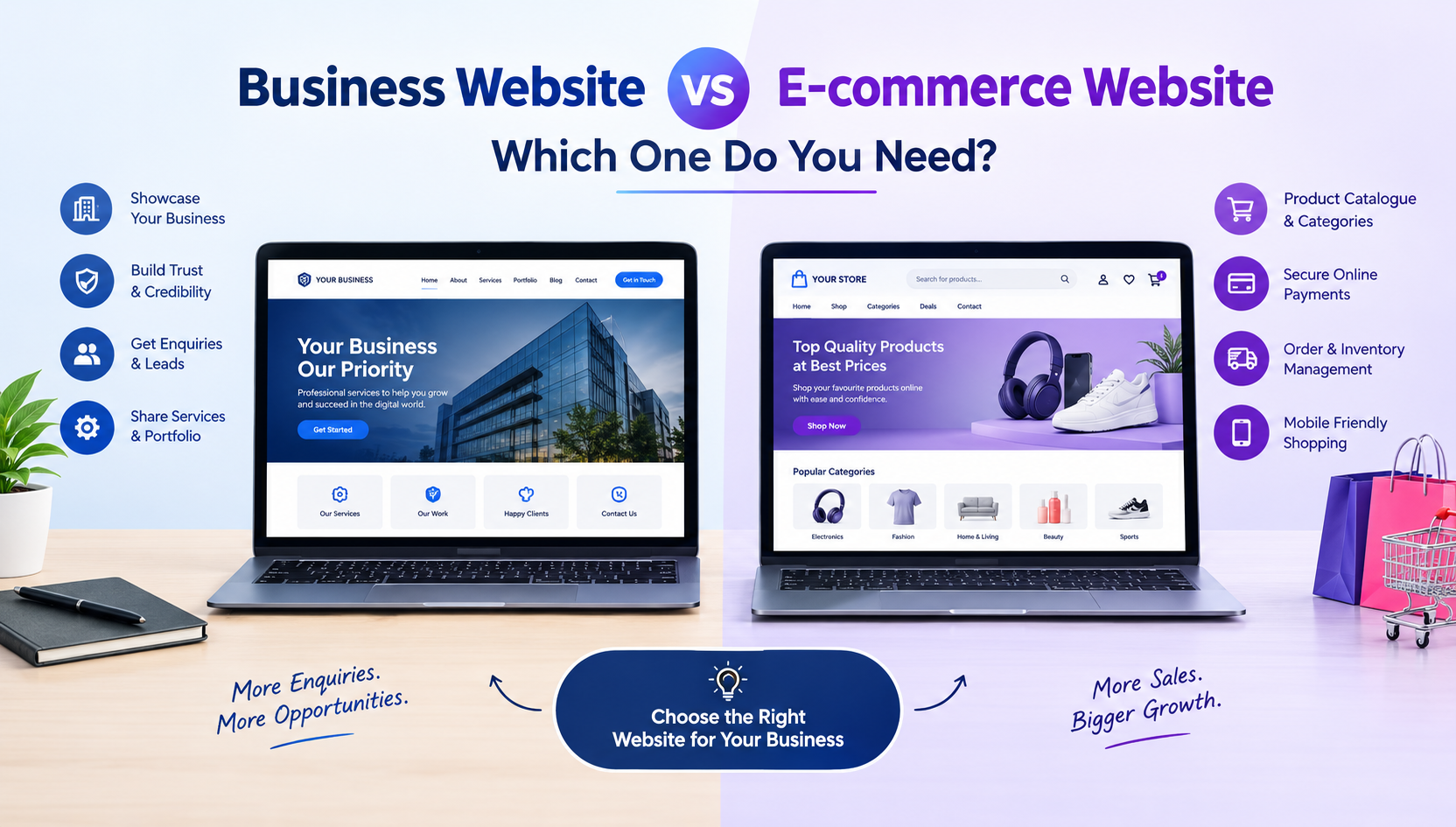
Choosing the right website is an important decision for any business. Whether you run a small shop, a service-based company, a startup, or an established brand, your website can help you reach more customers and grow your business online.
However, many business owners face one common question: Should I build a business website or an e-commerce website?
Both types of websites can help your business establish an online presence, but they serve different purposes. A business website mainly introduces your company, explains your services, and helps potential customers contact you. An e-commerce website allows customers to browse products, place orders, make online payments, and purchase items directly through the website.
So, which option is right for your business?
In this guide, we will explain the differences between a business website and an e-commerce website, their features, costs, benefits, and how to choose the right solution for your business.
What Is a Business Website?
A business website is an online platform that provides information about your company, products, services, experience, and contact details. Its main purpose is to build trust, attract potential customers, and generate enquiries.
For example, a website development company can showcase its services, previous projects, customer testimonials, and contact information. Visitors can explore the website and contact the company to discuss their requirements.
Business websites are suitable for companies that sell services, provide consultations, work on custom projects, or receive orders through phone calls and direct communication.
Key Features of a Business Website
A professional business website may include:
- Homepage: Introduces your business and highlights your main offerings.
- About Us page: Explains your company's background, experience, and values.
- Services page: Describes the services you provide.
- Portfolio: Showcases completed projects and previous work.
- Contact page: Displays your phone number, email address, location, and enquiry form.
- Blog section: Publishes useful information to attract visitors through search engines.
- Customer testimonials: Helps build confidence among potential customers.
- WhatsApp integration: Allows visitors to contact your team quickly.
- SEO-friendly structure: Helps search engines understand your website and its content.
The exact features depend on your business goals and the needs of your customers.
Who Should Choose a Business Website?
A business website is generally a good choice for:
- Website development and software companies
- Digital marketing agencies
- Consultants and professional service providers
- Educational institutions and coaching centres
- Construction and real estate businesses
- Hospitals, clinics, and other local service providers
- Manufacturers and distributors who primarily generate enquiries
- Startups looking to establish their brand online
If your customers usually contact you before purchasing a service or requesting a quotation, a business website may be the right starting point.
What Is an E-commerce Website?
An e-commerce website is an online store where customers can explore products, add items to their shopping carts, place orders, and pay online or choose an available alternative payment method.
Unlike a standard business website, an e-commerce website includes shopping and order-management functionality. It allows customers to complete many purchasing steps without speaking directly to a salesperson.
For example, a clothing store can display different products, sizes, colours, and prices. Customers can select their preferred items, enter their delivery details, and place orders through the website.
An e-commerce website can operate around the clock, allowing customers to shop whenever it is convenient for them.
Key Features of an E-commerce Website
A well-planned e-commerce website may include:
- Product catalogue: Displays products with images, descriptions, and prices.
- Product categories: Organises items into convenient sections.
- Shopping cart: Allows customers to add and review products before checkout.
- Online payment gateway: Supports available payment methods such as UPI, cards, and net banking.
- Cash on delivery: Can be offered where appropriate.
- Order management: Helps manage new orders, processing, shipping, and completed purchases.
- Inventory management: Tracks product availability and stock levels.
- Customer accounts: Allows customers to view their orders and manage account details.
- Shipping integration: Helps calculate delivery charges and coordinate shipments.
- Discounts and coupons: Supports promotional offers and seasonal sales.
- Mobile-friendly design: Makes shopping convenient on smartphones and tablets.
- Security features: Helps protect customer information and transactions.
Depending on the business model, an online store may also require product reviews, return management, GST-related invoicing, abandoned-cart recovery, or integration with accounting and inventory software.
Who Should Choose an E-commerce Website?
An e-commerce website is suitable for:
- Clothing and fashion brands
- Electronics and accessories stores
- Beauty and skincare businesses
- Furniture and home decor retailers
- Grocery and speciality food stores
- Wholesale and retail businesses
- Manufacturers selling directly to customers
- Businesses planning to sell products across India
- Brands looking to expand into online sales
If customers need to select products, place orders, and complete purchases online, an e-commerce website is usually the better choice.
Business Website vs E-commerce Website: Key Differences
Although both website types help businesses build an online presence, their primary functions are different.
FeatureBusiness WebsiteE-commerce WebsiteMain purposePromote the business and generate enquiriesSell products onlineProduct catalogueOptionalUsually essentialShopping cartNot normally requiredRequired for standard cart-based shoppingOnline paymentOptionalCommonly includedOrder managementUsually unnecessaryImportantInventory trackingOptionalImportant for stock-based sellingCustomer enquiriesA major goalUseful alongside online salesProduct deliveryNot normally requiredOften required for physical productsWebsite complexityOften simplerUsually more complexMaintenanceContent, security, updates, and performanceAll business website maintenance plus store operationsBest suited forService providers and lead generationRetailers and product sellers
The right choice depends on what you sell, how customers buy from you, and what you want your website to achieve.
Business Website vs E-commerce Website: Which Is More Affordable?
Website cost is another important factor when choosing between these two options.
A business website generally costs less because it may require only a few pages, a contact form, service information, and basic business features.
An e-commerce website usually requires additional development for product listings, shopping carts, checkout, payment integration, inventory, and order processing.
However, the final cost depends on the design, functionality, number of products, integrations, and level of customisation.
Factors That Affect Website Development Cost
For a business website:
- Number of pages
- Custom design requirements
- Content writing and image preparation
- Contact forms and WhatsApp integration
- SEO setup
- Additional features such as appointment booking
For an e-commerce website:
- Number of products and product variations
- Shopping cart and checkout functionality
- Payment gateway integration
- Shipping and delivery integrations
- Inventory and order management
- Customer accounts and promotional features
- Custom business rules and third-party integrations
Apart from development, remember to budget for domain registration, hosting, ongoing maintenance, security updates, and marketing.
Practical tip: Do not choose a website only because it is cheaper. Select the option that supports your business model without paying for unnecessary features.
Which Website Is Better for SEO and Google Rankings?
Both business websites and e-commerce websites can rank on Google. Neither type automatically receives better rankings simply because of its structure.
What matters is how useful, relevant, technically sound, and trustworthy the website is for its intended audience.
SEO for a Business Website
A business website can target keywords related to its services, industry, and location.
For example, a web development company in India may create useful pages targeting searches such as:
- Website development company in India
- Custom software development services
- Business website development services
- Website redesign services
- Web development company in Meerut
Each important service should have a clear page with original content, relevant examples, and a useful next step for visitors.
Publishing helpful blog posts can also answer customer questions and attract people who are researching services before making a decision.
SEO for an E-commerce Website
An e-commerce website can target product-related searches, category keywords, and specific buying queries.
For example:
- Buy office chairs online
- Best running shoes for men
- Affordable home decor products
- Buy handmade gifts online in India
E-commerce SEO often requires additional attention to product descriptions, category pages, product images, internal linking, page speed, structured data, and duplicate URLs caused by filters or sorting.
For both website types, mobile usability, helpful content, secure browsing, and a clear site structure are important.
Can a Business Website Generate Sales Without an Online Store?
Yes. A business website can generate sales even without a shopping cart or online payment system.
Many businesses sell services through enquiries, consultations, phone calls, WhatsApp conversations, and customised quotations.
For example, a software development company may receive a project enquiry through its website, discuss the customer's requirements, prepare a proposal, and close the deal offline or through a separate payment process.
Similarly, a manufacturer can display products on a business website and ask visitors to request pricing or a bulk quotation.
This approach is useful when prices depend on project requirements, quantities, specifications, or negotiations.
However, if customers frequently ask to purchase standard products directly online, adding e-commerce functionality may make the buying process easier.
Can You Combine a Business Website and an E-commerce Website?
Absolutely. You do not always have to choose between the two.
A website can combine business information, service pages, product listings, online sales, and customer support in one place.
For example, a computer hardware company could have:
- An About Us page explaining its experience
- Service pages for installation and maintenance
- Product categories for computers and accessories
- A shopping cart and online checkout
- A blog featuring buying guides and technical advice
- A contact page for bulk orders and corporate enquiries
This approach is particularly useful for businesses that sell products while also providing services.
You can start with the features your business needs today and expand the website as your requirements grow. However, the structure and technology should be planned carefully so that future additions do not require an expensive rebuild.
How to Choose the Right Website for Your Business
Before investing in website development, consider the following questions.
1. What Are You Selling?
If you primarily sell services, consultations, or customised solutions, a business website may be sufficient.
If you sell physical or digital products that customers can select and purchase directly, an e-commerce website may be more suitable.
2. How Do Your Customers Prefer to Buy?
Think about your existing sales process.
Do customers call you for a quotation? Do they discuss their requirements before making a purchase? Or do they prefer to compare products, add items to a cart, and pay online?
Your website should support the buying process your customers actually use.
3. What Is Your Budget?
If your budget is limited, starting with a professional business website can be a practical decision for a service-based company.
If online product sales are central to your business, invest in the essential e-commerce features from the beginning. Avoid spending on advanced features that are not necessary for your initial launch.
4. Do You Need Inventory and Order Management?
A standard business website may not require stock tracking or automated order processing.
An online store selling multiple products usually benefits from inventory controls, order notifications, shipping workflows, and payment reconciliation.
Consider these operational requirements before selecting your website type.
5. What Are Your Future Growth Plans?
Think beyond the initial launch.
Will you add more services? Start selling products online? Accept bulk orders? Expand to new cities? Integrate your website with CRM, accounting, or inventory software?
Choosing a flexible website structure can make future expansion easier.
6. Who Will Manage the Website?
Every website needs regular attention, but the workload differs.
A business website may mainly require content updates, security checks, and performance monitoring. An e-commerce website also needs product updates, stock management, order handling, payment monitoring, and customer support.
Make sure your team can manage these responsibilities or plan for ongoing professional support.
Common Mistakes to Avoid When Building a Website
Regardless of which website you choose, avoid these common mistakes:
Choosing features without a clear goal: Every feature should solve a real business problem or improve the customer experience.
Ignoring mobile users: Many visitors browse and purchase using smartphones. Your website should work properly on different screen sizes.
Using unclear content: Explain what you offer, who you help, and how visitors can take the next step.
Neglecting SEO: Search-friendly structure, useful content, appropriate page titles, and technical optimisation should be considered during development.
Overlooking security: Keep software updated, use HTTPS, manage access carefully, and follow appropriate security practices. E-commerce websites need particular attention to payment security and customer data protection.
Forgetting website maintenance: Backups, updates, monitoring, and regular testing help keep a website reliable.
Making contact difficult: Provide clear contact options, such as a phone number, enquiry form, or WhatsApp button, where appropriate.
Ignoring website performance: Slow pages can frustrate visitors and affect conversions. Optimise images, scripts, and other resources.
Frequently Asked Questions (FAQs)
1. What is the main difference between a business website and an e-commerce website?
A business website primarily presents company information, services, and contact details to generate enquiries and build trust. An e-commerce website includes shopping functionality that enables customers to browse products, place orders, and purchase items online.
2. Which website is better for a small business?
The best option depends on the business model. A service provider may need only a professional business website, while a retailer selling products online may benefit more from an e-commerce website.
3. Is an e-commerce website more expensive than a business website?
An e-commerce website often costs more because it requires additional functionality, such as product management, checkout, payment integration, and order processing. Actual pricing depends on the project's scope and complexity.
4. Can I start with a business website and add e-commerce later?
Yes. You can begin with a business website and add an online store later, provided the chosen platform and website architecture support the required functionality.
5. Do I need an e-commerce website to accept online payments?
No. Depending on your business process, you may accept payments through other suitable payment methods or payment links. An e-commerce website is particularly useful when you want customers to select products and complete purchases directly through your website.
6. Which website is better for Google rankings?
Both can rank well in search results. Rankings depend on factors such as content relevance, technical SEO, website experience, competition, and the quality of the overall site.
7. Can a business website sell products?
Yes. A business website can display products and collect enquiries or quotation requests. If you want customers to complete purchases through a shopping cart and checkout, you will generally need e-commerce functionality.
8. How do I choose a reliable website development company in India?
Look for relevant experience, a portfolio of completed projects, transparent pricing, clear communication, mobile-friendly development, SEO knowledge, security practices, and post-launch support. Ask for a detailed proposal before making your decision.
Final Thoughts
A business website and an e-commerce website both have an important role in helping businesses grow online. The right choice depends on what you sell, how your customers make purchasing decisions, and what you expect your website to achieve.
If your main goal is to showcase your services, build credibility, and receive customer enquiries, a business website may be the ideal solution.
If you want customers to browse products, place orders, and pay online, an e-commerce website is likely the better choice.
And if your business needs both service enquiries and online sales, a combined website can give you the flexibility to manage everything in one place.
Need help choosing the right website for your business?
BEGRIDS provides website design and development services tailored to different business requirements. Whether you need a professional company website, a custom-built solution, or an e-commerce store, the first step is to understand your goals and choose the right features.
Visit https://www.begrids.com/ to explore BEGRIDS and discuss a website solution that fits your business needs.
Build a website that works for your business—not just one that looks good.