
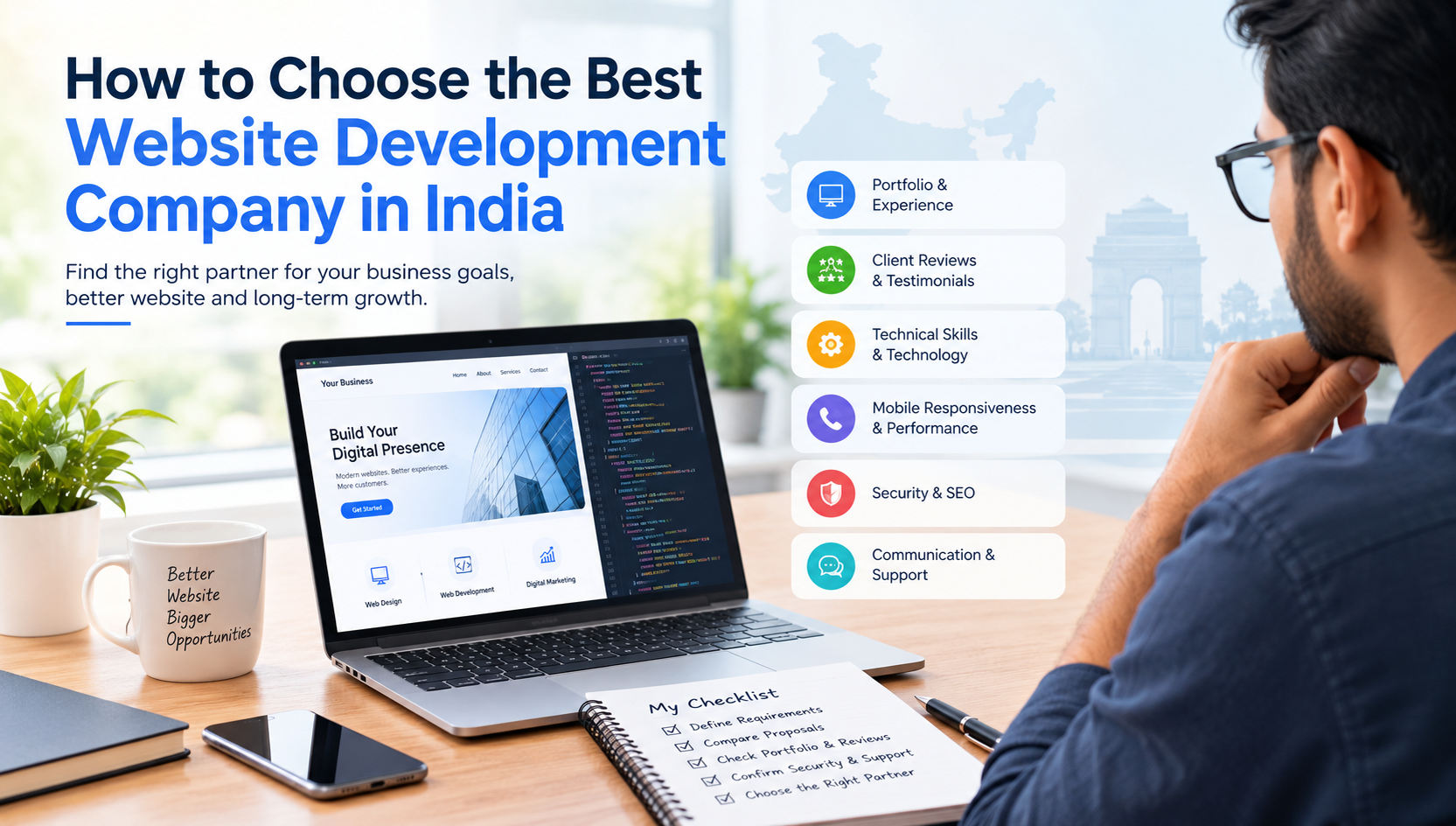
Choosing the right website development company is an important decision for any business. Your website is often the first place potential customers visit to learn about your products, services, and company. A well-designed website can build trust, attract new customers, and help your business grow. On the other hand, a poorly developed website can drive visitors away before they even contact you.
With so many web development agencies available across India, finding the right partner can feel confusing. Every company promises quality work, affordable pricing, and timely delivery. But how do you know which one can actually understand your business and deliver the results you need?
The answer is to look beyond attractive designs and low prices. You need a company that understands your goals, communicates clearly, uses the right technology, and provides support even after your website goes live.
In this guide, we will explain how to choose the best website development company in India, what factors to consider, which questions to ask, and how to avoid common mistakes.
Why Choosing the Right Website Development Company Matters
A business website is more than an online brochure. It can help you generate leads, receive enquiries, sell products, explain your services, and establish credibility with potential customers.
The right development company will consider your business requirements before starting the project. It will focus on creating a website that is easy to navigate, works smoothly on mobile devices, loads quickly, and supports your long-term business plans.
For example, a small service business may need a professional website with contact forms and service pages. An online store may require product management, secure payment integration, order tracking, and inventory features. A growing company may need custom software, customer management tools, or connections with other business systems.
Each requirement calls for a different approach. That is why choosing a development partner based on your actual needs is more important than simply selecting the cheapest package.
1. Understand Your Website Requirements First
Before contacting a website development company, take some time to identify what you want your website to achieve.
Ask yourself a few basic questions:
- Do you need a business website, an e-commerce store, or a web application?
- Who are your target customers?
- What products or services will you display?
- Do you need online payments, booking forms, customer accounts, or a product catalogue?
- Will you need regular updates or additional features in the future?
- What is your approximate budget and expected launch date?
You do not need to prepare a technical document. A clear explanation of your business, audience, and goals is enough to begin a productive discussion.
When your requirements are clear, it becomes easier to compare proposals and identify a company that can deliver the right solution.
2. Check the Company's Portfolio and Previous Work
One of the most reliable ways to evaluate a website development company is to review its previous projects.
Visit the websites listed in its portfolio instead of judging everything from screenshots. Open them on your computer and mobile phone. Explore different pages, test the forms, and see how easily you can find information.
Pay attention to the following:
- Design quality: Does the website look professional and suit the business?
- Mobile responsiveness: Does it work properly on smartphones and tablets?
- Navigation: Can visitors find important information without confusion?
- Loading speed: Do the pages load smoothly?
- Functionality: Do forms, menus, search features, and other elements work correctly?
- Business relevance: Has the company handled projects similar to yours?
A portfolio should demonstrate more than visual creativity. It should show that the development team can build practical websites that serve real business needs.
If a company has limited public examples, ask whether it can demonstrate relevant work or explain how it would approach your project.
3. Read Client Reviews and Testimonials
Customer feedback can help you understand what it is like to work with a development company.
Check independent platforms such as Google Business Profile, GoodFirms, and Clutch where relevant reviews are available. Look for detailed feedback that describes the project's scope, communication, delivery, and support.
Do not focus only on the overall rating. Read the actual comments.
Look for answers to these questions:
- Did the company understand the client's requirements?
- Was the project delivered within the agreed timeline?
- Were changes handled professionally?
- Did the final website meet expectations?
- Was support available after launch?
If possible, ask the company for references from previous clients with similar projects. A brief conversation with a past customer can sometimes reveal more than a long list of testimonials.
4. Evaluate Technical Skills and Development Experience
Different websites require different technologies. A company that specialises in basic business websites may not be the best choice for a complex online platform.
Depending on your requirements, check the team's experience with technologies such as:
- HTML, CSS, JavaScript, and Bootstrap
- PHP and CodeIgniter
- WordPress and other content management systems
- Laravel and custom web applications
- React and modern frontend frameworks
- MySQL and other suitable database systems
- E-commerce platforms and payment integrations
The goal is not to choose a company simply because it uses the newest technology. The goal is to find a team that can explain why a particular technology suits your project.
For example, a simple company website may not need a complicated custom-built system. However, a business that requires specialised workflows, reporting, customer portals, or integrations may benefit from custom website development.
A capable development partner should explain the advantages, limitations, maintenance requirements, and likely future costs of its proposed solution.
5. Make Sure the Website Is Mobile-Friendly
Many people browse websites on their smartphones before making a purchase or contacting a business. If your website is difficult to use on a small screen, you could lose potential customers.
A responsive website automatically adjusts its layout to different screen sizes.
When evaluating a development company, ask whether it tests websites on different devices and browsers. Check that text is readable, buttons are easy to tap, forms are convenient to complete, and menus work correctly.
Mobile responsiveness is also an important part of providing a good user experience and supporting search engine performance.
Do not accept a website simply because it opens on a mobile phone. It should be comfortable to use.
6. Check Website Speed and Performance
Visitors expect websites to load quickly. Slow pages can frustrate users and discourage them from exploring your services.
A professional website development company should consider performance throughout the development process, not only after the website is complete.
Important factors include:
- Optimised images and other media
- Efficient code and scripts
- Suitable hosting and server configuration
- Browser caching where appropriate
- Lightweight page layouts
- Performance testing on mobile and desktop devices
You can use tools such as Google PageSpeed Insights to review a website's performance and identify possible improvements.
Remember that speed depends on several factors, including hosting, third-party services, content, and traffic. No company should promise perfect performance under every possible condition without explaining the testing environment and limitations.
7. Choose a Company That Understands SEO
A website may look impressive, but it still needs to be discoverable by the people searching for your products or services.
That is why it is useful to choose a website development company in India that understands SEO-friendly website development.
Technical SEO considerations should be included in the website structure from the beginning.
Check whether the company can provide:
- Search-engine-friendly URLs
- Editable page titles and meta descriptions
- Proper heading structure
- XML sitemap and robots.txt configuration
- Canonical tags where required
- Appropriate image alt text
- Mobile-friendly page layouts
- HTTPS configuration
- Structured data where relevant
- A clean internal linking structure
If organic traffic is a major business goal, ask whether keyword research, content planning, and ongoing SEO services are included in the proposal or offered separately.
A technically sound website creates a better foundation for SEO, but it does not guarantee first-page rankings. Search visibility also depends on content quality, competition, authority, and many other factors.
8. Compare Pricing, Not Just the Cheapest Quote
Website development costs in India vary depending on the number of pages, design complexity, functionality, integrations, content requirements, and level of customisation.
A basic business website generally costs less than an e-commerce platform or a custom web application. Two proposals with very different prices may also include very different deliverables.
Before choosing a company, request a written quotation that clearly explains what is included.
Compare the following:
Cost factorWhat to checkDesignCustom design or ready-made templateDevelopmentPages, features, and integrations includedContentWhether writing and image selection are includedSEOTechnical setup or ongoing optimisationDomain and hostingIncluded, separate, or renewableSecuritySSL, backups, and protection measuresMaintenanceUpdates, bug fixes, and support periodAdditional workCharges for changes beyond the agreed scope
A low initial quote may become expensive if essential features, content, or maintenance are charged separately.
At the same time, a higher price does not automatically mean better quality. Compare the scope, experience, deliverables, and support before making your decision.
9. Ask About Website Security
Security should be considered from the beginning, especially if your website collects customer information, accepts payments, or provides user accounts.
Ask the development company how it plans to protect your website and data.
Depending on the project, important measures may include:
- HTTPS and SSL configuration
- Secure authentication and password handling
- Input validation and protection against common web attacks
- Role-based access controls
- Regular software and dependency updates
- Database backups and recovery procedures
- Secure payment gateway integration
- Protection of API keys and other credentials
No website can be guaranteed completely immune to security problems. However, a responsible development team should follow appropriate security practices and explain how issues will be handled if they occur.
You should also know who is responsible for updates, backups, and security monitoring after launch.
10. Evaluate Communication and Project Management
Good communication can make the difference between a smooth project and a frustrating experience.
During your first conversation, notice whether the company listens carefully, asks relevant questions, and explains technical matters in understandable language.
A reliable website development partner should establish:
- A clear project scope
- A realistic delivery schedule
- Regular progress updates
- A process for feedback and revisions
- A primary point of contact
- Approval stages before launch
- Clear responsibilities for both parties
Ask how you will review the website during development. Will you receive a staging link? Can you test the pages before launch? How will requested changes be documented?
These details help prevent misunderstandings and keep the project moving in the right direction.
11. Confirm Website Ownership and Access
This is an important point that many businesses overlook.
Your website should not leave you dependent on a developer for every small change or account-related issue.
Before signing an agreement, confirm who will own and control:
- The domain name
- The hosting account
- Website source code and deliverables
- Database and website files
- Administrative accounts
- Paid themes, fonts, plugins, and licences
- Third-party services and integrations
Make sure the agreement clearly states the ownership and transfer terms for custom-developed work and any third-party components.
Where appropriate, register the domain and hosting in your business's name. Obtain the necessary administrator access and a backup of the completed website.
A professional company should be comfortable discussing these arrangements before work begins.
12. Check Post-Launch Support and Maintenance
Launching a website is not the end of the process. Over time, you may need new pages, content updates, software upgrades, security fixes, or improvements based on customer feedback.
Ask what happens after the website goes live.
Find out whether the company offers:
- Bug fixing during an agreed warranty period
- Technical support
- Website backups
- Security updates
- Content and design changes
- Performance improvements
- Additional feature development
Clarify the support period, response expectations, and charges for work outside the agreed scope.
If your business depends heavily on its website, consider arranging a maintenance plan rather than waiting for a problem to appear.
13. Look for a Long-Term Business Partner
Your website should be able to support your business as it grows.
You may start with a small company website and later need a blog, online payments, customer dashboards, CRM integration, an inventory system, or a mobile application.
A development company that understands your long-term plans can help you make practical decisions today without creating unnecessary limitations for tomorrow.
Ask how the website can be expanded in the future, what changes might require additional investment, and whether the proposed architecture is suitable for your expected needs.
The best partner is not necessarily the largest agency. It is the company that offers the right combination of technical ability, clear communication, reliable delivery, and ongoing support for your business.
Common Mistakes to Avoid When Hiring a Website Development Company
Even with careful research, businesses sometimes make decisions that lead to unnecessary expenses or disappointing results.
Avoid these common mistakes:
Choosing only on price: A cheap website may lack important features, proper testing, or adequate support.
Ignoring previous work: A persuasive sales presentation cannot replace evidence of actual development experience.
Starting without a written scope: Unclear requirements can lead to delays, disagreements, and unexpected costs.
Expecting guaranteed Google rankings: Website development supports SEO, but rankings depend on many factors beyond the developer's control.
Overlooking ownership: Make sure you understand your rights to the website, source code, domain, and accounts.
Skipping security and backups: A website needs an appropriate plan for protection, maintenance, and recovery.
Ignoring post-launch support: Find out who will help when something breaks or when your business needs a change.
Taking time to check these points before signing a contract can save money and prevent problems later.
Questions to Ask Before Hiring a Website Development Company
Before making your final decision, ask the shortlisted companies a few practical questions:
- Have you developed websites for businesses similar to mine?
- What technology do you recommend for my requirements, and why?
- What exactly is included in the quoted price?
- Who will write the website content and handle SEO setup?
- How will you test the website before launch?
- What is the expected delivery timeline?
- Who will own the source code and administrative accounts?
- What support and maintenance are available after launch?
- What are the additional costs I should plan for?
- Can I review the website and provide feedback during development?
Pay attention not only to the answers but also to how clearly they are explained. A good company should be able to discuss both the benefits and limitations of its proposed approach.
Why Choose BeGrids for Website Development?
If you are looking for a website development company in India, BeGrids can be a partner to consider for building a professional online presence for your business.
At BeGrids, the focus is on understanding business requirements and creating practical digital solutions that support your goals.
Whether you are launching a new business, improving an existing website, or planning a more customised online platform, the right approach begins with understanding what your business actually needs.
BeGrids offers services across website design and development, digital marketing, SEO, custom software development, and related digital solutions.
Depending on your project requirements, your website can be planned around:
- Professional and responsive website design
- Business-focused page structure and navigation
- Custom website functionality
- SEO-friendly technical foundations
- Suitable integrations and business tools
- Future improvements and ongoing digital growth
Every project has different requirements, so the right solution should be discussed according to your objectives, preferred features, and budget.
Looking for a website development company for your business?
Visit www.begrids.com to explore BeGrids services and discuss your website requirements.
Share your business goals, the features you need, and your expected timeline so you can identify a suitable development approach.
Final Thoughts
Choosing the best website development company in India requires more than comparing prices or selecting the most attractive portfolio. You need a development partner that understands your business, recommends suitable technology, builds a reliable website, and provides clear terms for ownership and ongoing support.
Start by defining your requirements. Review previous projects, read genuine client feedback, compare detailed quotations, and discuss security, SEO, communication, and maintenance before making a decision.
Most importantly, choose a company that values your business goals as much as the technical work.
A well-planned website can become a valuable business asset, helping you establish credibility, connect with potential customers, and create opportunities for long-term growth.
Take your time, ask the right questions, and choose a website development partner you can work with confidently.
Frequently Asked Questions (FAQs)
1. How do I choose the best website development company in India?
Review the company's portfolio, technical experience, genuine client feedback, pricing, communication process, security practices, and post-launch support. Choose a company that understands your business requirements and provides a clear written proposal.
2. How much does website development cost in India?
The cost depends on the website type, number of pages, design requirements, functionality, integrations, content, and maintenance. A basic business website usually costs less than a custom web application or a feature-rich e-commerce website. Request a detailed quotation based on your requirements.
3. How long does it take to develop a website?
A simple business website may take a few weeks, while a larger e-commerce website or custom web application can take several months. The timeline depends on project complexity, content availability, feedback, and testing.
4. Why is SEO important during website development?
SEO-friendly development helps search engines discover, crawl, and understand website content. It includes factors such as page structure, mobile responsiveness, metadata, URLs, internal linking, and performance. Ongoing SEO work may still be necessary to improve search visibility.
5. Should I choose a freelancer or a website development company?
A freelancer may suit a small, clearly defined project. A development company may be a better fit when you need multiple skills, structured project management, ongoing support, or more complex functionality. The right choice depends on your requirements, budget, and expected level of service.
6. What should I receive after my website is completed?
Depending on your agreement, you should receive the completed website, relevant source code and files, administrative access, database and backup information, configuration details, and applicable licences or documentation. Confirm ownership and handover terms in writing before development begins.
7. Does BeGrids provide website development services?
BeGrids provides website design and development alongside digital marketing, SEO, and software-related services. Visit begrids.com to explore the available services and discuss your project requirements.